Newcastle Disease Virus current situation in Nigeria


Ventilation Management
It is very important to study the Effective Temperature, which is the actual temperature perceived by the bird and is influenced by the interaction between:
1- Ambient temperature
2- Humidity
3- Air speed
Heat Stress Number
There is a strong relationship between dry air temperature and relative humidity (the amount of water vapor in the air). Their combined value produces heat stress on the bird and is expressed as:
Heat Stress Number = Temperature (°F) + Relative Humidity (%)
Temperature Conversion:
To convert Celsius to Fahrenheit:
°F = (°C × 9/5) + 32
To convert Fahrenheit to Celsius:
°C = (°F − 32) × 5/9
Heat Stress Interpretation:
If the sum < 150 → No problem
If it reaches 155 → Beginning of stress
If it reaches 160 → Feed intake stops, water intake increases, production decreases
If it reaches 165 → Mortality begins
If it reaches 170 → Severe mortality (real catastrophe)
Heat Transfer Methods
Heat transfer from any body occurs through three methods:
Radiation — Convection — Conduction
Birds radiate heat from their bodies sufficient to warm themselves in cold environments.
A bird weighing 1 kg radiates 5.5–6.5 kcal/hour.
Thus, a 21‑day‑old bird weighing 1 kg can maintain warmth without air drafts.
Factors Affecting House Ventilation
1- Outside temperature
2- Wind speed
3- Thermal conductivity
4- Air exchange rate inside the house
5- Atmospheric pressure
6- Heat radiation from birds
Negative Effects of Ammonia
Ammonia has harmful effects on birds, causing:
Reduced daily weight gain — Skin irritation — Breast burns — Eye inflammation — Footpad burns — Increased heart rate — Poor flock uniformity
Effect of Ammonia Levels on Feed Intake and Weight
Ammonia concentration — Feed consumption — Body weight
0 ppm → 2.19 kg — 1.56 kg
25 ppm → 2.14 kg — 1.44 kg
50 ppm → 1.86 kg — 1.16 kg
Thus, increasing ammonia levels reduces feed intake and body weight.
Required Air Quality Levels
1- Recommended ammonia level ≤ 10 ppm
2- Detectable by humans at 5 ppm
3- At 20 ppm → Affects respiratory cilia
4- At 25–50 ppm → Reduced body weight and feed conversion
Ventilation
Ventilation stages according to environmental conditions:
1- Minimum Ventilation
2- Transitional Ventilation
3- Tunnel Ventilation
Minimum Ventilation System
Used during cold weather and brooding periods.
Used to change air without lowering house temperature.
Operates using a timer.
Used only in the early days of bird age.
Prevents moisture buildup, ammonia, and CO₂ accumulation.
Air speed ≤ 0.2 m/s
Air exchange once every 5 minutes
Purposes:
Providing oxygen — Controlling humidity — Maintaining litter quality
This system depends on negative pressure.
Negative Pressure
Negative pressure means exhausting air from inside the house so fresh air enters through inlets, creating a partial vacuum.
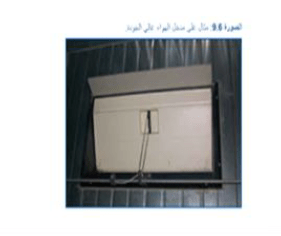
Pressure should not exceed 25 Pascals.
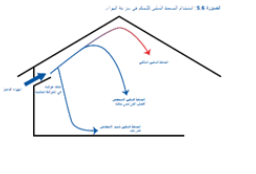
Transitional Ventilation
Used when house temperature exceeds outside temperature.
Air speed ≈ 0.5 m/s
Air exchange once every 2 minutes
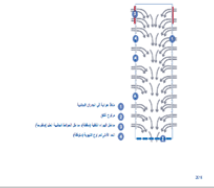
Used from day 10 to day 28
Tunnel Ventilation
Used in hot weather to reduce house temperature.
Air speed 1.7–2.5 m/s
Air exchange once per minute
May use evaporative cooling pads
Not used before 28 days of age
House Volume Calculation
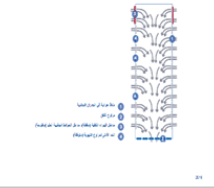
House volume = Length × Width × Average height
Example:
100 × 14 × 2.7 = 3780 m³
Minimum ventilation airflow:
3780 ÷ 5 = 756 m³/min
Fan capacity example:
42,500 m³/hour = 708 m³/min
Number of fans:
756 ÷ 708 ≈ 1 fan
Tunnel ventilation calculation:
Cross‑sectional area:
13.8 × 2.7 = 37.26 m²
Required airflow:
37.26 × 2.5 = 93.15 m³/s
Fan capacity:
11.8 m³/s
Number of fans:
93.15 ÷ 11.8 ≈ 8 fans
Cooling Pad Area Calculation
Pad area depends on airflow and pad thickness.
To calculate the cooling pad area, the following must be known:
Air volume = Cross-sectional area × Air velocity
= 37.26 × 2.5
= 93.15 m³/s
Required pad area = Air volume ÷ Air velocity through pads
= 93.15 ÷ 2
= 46.75 m²
Assuming pad height = 1.5 m
Pad length = 46.75 ÷ 1.5
= 31.2 m
If installed on two sides:
Length per side = 31.2 ÷ 2
= 15.6 m per side
Air velocity = 1.25 m/s
Pad area = 93.15 ÷ 1.25
= 74.5 m²
With pad height 1.5 m:
Pad length = 74.5 ÷ 1.5
= ≈ 50 m
On two sides:
Length per side = 50 ÷ 2
= 25 m per side
Prepared by:
Eng. Nader Saeed El‑Hadary