The Impact of Mycoplasma in Laying Hens Focusing on Egg Quality, Immunity, and its Role in Predisposing for Viral Infections


Disease Definition Adenoviruses belong to the group of viruses containing deoxyribonucleic acid (DNA). The infection is globally distributed among many animals, humans, and birds; however, each virus type is host-specific (highly host-restricted) and generally does not infect a different host species.
Pathogenesis and Immunosuppression The severity of Adenovirus infection lies not only in the clinical symptoms it produces but also in its role as a potent immunosuppressive agent. The virus causes the destruction of B-cells in the Bursa of Fabricius and depletes cells in several organs that regulate the immune system, such as the thymus, the spleen, and the respiratory epithelial cells. This significantly increases susceptibility to secondary infections.
Environmental Resistance The virus is considered highly resistant to external environmental factors, including high temperatures, ultraviolet (UV) radiation, and certain chemical disinfectants.
Incubation Period The incubation period varies according to the serotype; in some cases, it lasts for several days, while in others, it extends to several weeks. Generally, the incubation period is approximately three weeks. Consequently, clinical signs typically appear in chicks hatched from infected breeders at three weeks of age.
Classification Adenoviruses are divided into three groups. Group I infects chickens and comprises 12 serotypes. Serotype 1 is identified as the primary causative agent of fowl adenovirus infection.

2-Distension of the pericardial sac, which often contains a watery fluid (known as Hydropericardium).
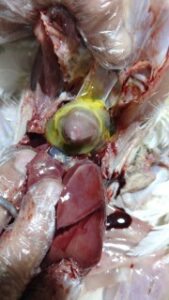
3-Hepatomegaly (liver enlargement) and hepatic necrosis, characterized by a yellowish discoloration and a mottled appearance.

4-Pallor and enlargement of the kidneys (nephromegaly), accompanied by hemorrhagic and necrotic foci that give them a mottled (speckled) appearance.
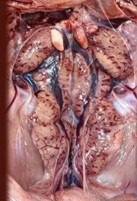
5- Pancreatic necrosis.

Presence of large basophilic intranuclear inclusion bodies within the hepatocytes.
Diagnosis is based on case history, clinical signs, and gross lesions. Laboratory diagnosis is performed via histopathology, tissue culture, or egg embryo inoculation. Additional diagnostic tools include the HI test (Hemagglutination Inhibition), Agar Gel Precipitation Test (AGPT), or ELISA.
Adenovirus infection must be differentiated from other viral infections such as Newcastle Disease (ND), Infectious Bronchitis (IB), and Infectious Laryngotracheitis (ILT).
Immunization of breeder flocks using inactivated vaccines, administered at least twice during the rearing period to ensure the transfer of sufficient maternal immunity to the progeny (chicks).