The Impact of Mycoplasma in Laying Hens Focusing on Egg Quality, Immunity, and its Role in Predisposing for Viral Infections


Abstract
Newcastle Disease (ND) remains a significant threat to the Pakistani poultry industry, causing substantial economic losses despite routine vaccination. The constant evolution of the virus, particularly the emergence of genotype VII field strain often leads to vaccine breaks with traditional genotypes. This field trial was conducted on a commercial broiler farm of 5,000 birds to evaluate the efficacy of three different ND vaccine strains. The birds were divided into four groups of 1,250 each. The trial demonstrated that a genotype matched vaccine (G7) provided a better protection, a bit higher antibody titers, and reduced mortality compared to traditional La Sota and Clone 30 vaccines.
Introduction
Newcastle Disease (paramyxovirus serotype-1) is endemic in Pakistan, with the velogenic viscerotropic form (predominantly Genotype VII) being the most prevalent field challenge . In my eighteen years of working with Poultry Grandparent (GP) stocks and the last eight years as a consultant, I have observed that vaccine failures are increasingly common not due to poor vaccine quality alone, but due to antigenic mismatch between traditional vaccines (Genotype II strains like La Sota) and circulating field strains (Genotype VII) .
This article outlines a practical, field tested protocol comparing three vaccination strategies to determine the most effective control method under local farming conditions.
Materials and Methods
Farm and Stock
The trial was conducted at a commercial broiler farm under standard open sided housing conditions prevalent in Pakistan. A total of 5,000 day old broiler chicks from a consistent parent stock source were randomly allocated into four equal groups of 1,250 birds each. The groups were physically separated with strict barriers to prevent cross-contamination.
Group Design (Vaccine Strain Comparison)
3· Group C (Clone 30 – Genotype II): Received live Clone 30 vaccine (≥6.0 log10 EID50/dose) via eye drop on day 7 and booster via drinking water on day 21 .
4· Group D (ND G7 – Genotype VII): Received inactivated ND G7 emulsion vaccine (genotype VII) on day 7, plus a live La Sota and booster of Lasota on day 21 as per standard “priming” protocols .
Challenge
A mild field challenge was simulated by introducing sentinel birds from a non vaccinated source into the environment of all groups at day 21 to mimic natural field exposure to prevalent genotype VII virus.
Parameters Measured
Results
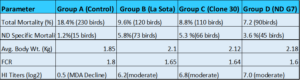
The data collected at the end of the 38 day cycle showed some differences in protection levels between the vaccine strains.
Discussion
The results clearly demonstrate that vaccine strain selection is critical for effective ND control in an era of evolving virus genotypes.
Conclusion and Recommendations for the Field
Based on this trial, the following conclusions are drawn for ND control in Pakistan:
Recommended Protocol for High-Risk Areas:
Final Word:
Viruses Evolve; our vaccination strategies must evolve with it. By matching the vaccine to the field strain, we can achieve protection levels that our farmers desperately need.